Bi-material tooling inserts: An Innovation in Injection Mould Thermal Design
Introducing a breakthrough in tooling design:
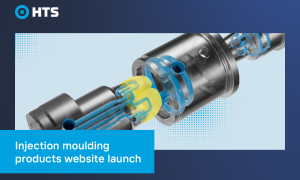
HTS developed a proprietary new AM technology: a next-generation high-performance tooling insert built on a true bi-material architecture, engineered to deliver thermal control precisely where it matters most.
At its core: a high-conductivity copper alloy, integrated with conformal cooling channels strategically positioned to maximize heat extraction from the critical regions of the cavity.
Encasing it: a high-strength tool-steel shell delivering the hardness, wear resistance, stiffness, and thermal cycling durability required for industrial production.
But the real performance advantage lies in the heat path.
A fully bonded, continuous copper–steel interface creates an uninterrupted thermal bridge from the cavity surface directly into the copper core and into the conformal cooling network. No thermal bottlenecks. Minimal interfacial resistance. Maximum heat flow.
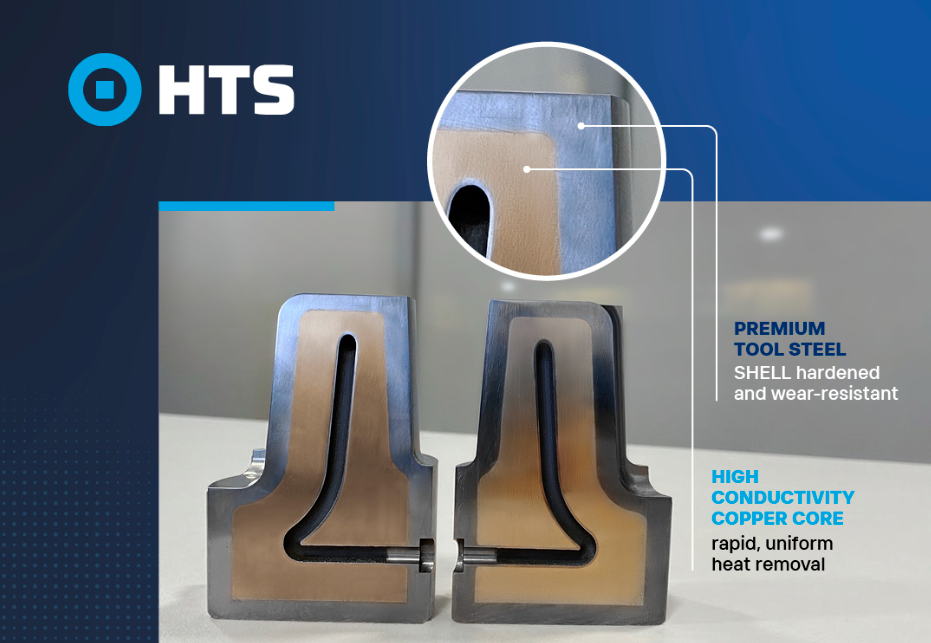
By minimizing interfacial thermal resistance, heat is removed faster, which translates into a shorter cooling window, reduced thermal gradients, and a more stable process window.
Simulation versus a conventional insert showed:
- Significant reduction in ΔT across the working surfaces (-37°C)
- Improved heat extraction during cooling phase, for faster solidification times
- Lover thermal gradients and balanced temperature distribution
- up to 25% projected productivity uplift via shorter cycle time
This is not incremental cooling optimization. It’s a new architectural approach to mould thermal design.